Porcelain lasts longer on a floor. It is fired denser, absorbs less than 0.5% water, carries higher wear ratings, and hides chips better than glazed ceramic. Ceramic still earns its place on walls, backsplashes, and light-traffic rooms — where its lower cost and easier cutting are real advantages.
Walk the tile aisle and the two materials sit side by side, often in near-identical patterns. The label is sometimes the only visible difference, until a few years of foot traffic, dropped pans, and mopping reveal which one you actually bought. SD Assembly Pros installs both across San Diego County as part of its tile and flooring service, and which one to buy is the first decision in most tile projects. Here is the plain answer.
What Actually Separates Porcelain From Ceramic?
Porcelain and ceramic are both clay tiles fired in a kiln, and porcelain is technically a type of ceramic. What separates them is density: porcelain is pressed from finer clay and fired hotter, so its body absorbs 0.5% of its weight in water or less.
That absorption figure is the industry line between the two: a tile qualifies as porcelain only if its body stays at or under 0.5%. Standard ceramic absorbs more, often several times more.
That single number drives almost everything else. A dense, nearly waterproof body is harder, heavier, and more resistant to surface wear. It also means porcelain shrugs off spills, pet accidents, and wet mopping without slowly drinking moisture into the tile itself. Ceramic's more porous body is protected only by its glaze — the thin glass layer on top. As long as the glaze is intact, a ceramic floor performs well. Once the glaze wears or chips, the softer body underneath is exposed, and that is where ceramic floors start to show their age.
How Do Porcelain and Ceramic Compare Side by Side?
Porcelain and ceramic differ most on water absorption, wear rating and how hard they are to cut, the specs that matter for a floor. PEI class is the wear rating printed on the box: it shows how much foot traffic the glazed surface is built to take, from class 1 (very light traffic) up to class 5 (heavy commercial floors).
| Spec | Porcelain | Ceramic |
|---|---|---|
| Water absorption | Less than 0.5% | Above 0.5%; varies widely by product |
| Typical PEI wear class | Commonly 3–5 (check the box) | Commonly 1–3 (walls and lighter-traffic floors) |
| Chip visibility | Low — body color runs near or through the tile | High — chips expose a contrasting clay body |
| Cutting difficulty | Hard — needs a quality wet saw and diamond blade | Easy — snap cutters handle most cuts |
| Outdoor use | Yes, when the tile is rated for exterior use | Not recommended |
| Relative cost | Moderately higher per square foot | Lower — the budget-friendly option |
The chip row deserves a closer look, because it is the difference homeowners notice most. Drop a cast-iron pan on glazed ceramic and the chip exposes a white or terracotta body that contrasts sharply with the surface — a small chip reads as a flaw from across the room. Through-body and color-body porcelain carry the surface color into the tile itself, so the same impact leaves a mark you have to hunt for. Over a fifteen-year life, that is the difference between a floor that ages gracefully and one that collects visible battle scars.
Identifying mystery tile: the fastest way to identify tile in an older home is to flip a spare or look at a chipped edge. A reddish or bright-white body under the glaze means ceramic; a dense, uniform, stone-like body means porcelain. This helps in older houses where the original boxes are long gone and you need matching tile for a repair.
When Is Ceramic Tile the Smarter Choice?
Ceramic tile is the smarter choice on walls, backsplashes and floors that see light use. Nothing walks on a wall, so the wear class is irrelevant there and the density of porcelain buys you nothing. The softer ceramic body also cuts cleanly with a simple snap cutter.
That matters when a backsplash needs a dozen precise notches around outlets and window sills. Backsplashes and wall tile are part of our tile and flooring service.
Ceramic also makes sense on floors that see gentle use — a guest bathroom, a laundry room, a rarely used hallway. A floor-rated ceramic in a low-traffic room can outlast the owner's taste in tile, at a noticeably lower material cost. If you are tiling a large area on a tight budget, spending the savings on proper substrate prep will do more for the floor's lifespan than upgrading the tile would.
- Choose porcelain for: kitchens, entryways, showers and bathroom floors, patios and outdoor steps, homes with big dogs, and any floor you intend to keep for decades.
- Choose ceramic for: backsplashes, shower and accent walls, guest baths, laundry rooms, and budget-conscious projects in lighter-traffic rooms.
- Either works for: powder rooms, closets, and utility spaces — pick on price and looks, not durability.
Which Tile Holds Up Best in San Diego Homes?
Porcelain tile holds up best in most San Diego homes, especially near the coast and outdoors. The climate is kind to tile, with no freeze-thaw cycles and mild humidity, but tracked-in sand and indoor-outdoor living both favor the denser material.
Coastal homes from Ocean Beach to Carlsbad live with salt air and sandy grit tracked in year-round, and sand is an abrasive: it works on a glazed ceramic surface like fine sandpaper under every footstep. Indoor-outdoor living means patios, where porcelain is the usual choice and porous ceramic is generally not recommended. Check that the specific tile is rated for exterior use before ordering.
Durability is only half the lifespan equation, though. The other half is maintenance — and on a tile floor, the grout gives out long before the tile does. Porcelain can outlive the house it is installed in, but the cement grout between the tiles is porous, stains, and eventually needs resealing. We wrote a separate guide on how to clean grout without damaging it, because more "worn out" tile floors are actually just tired grout than most homeowners realize.
Does Porcelain Change the Installation Job?
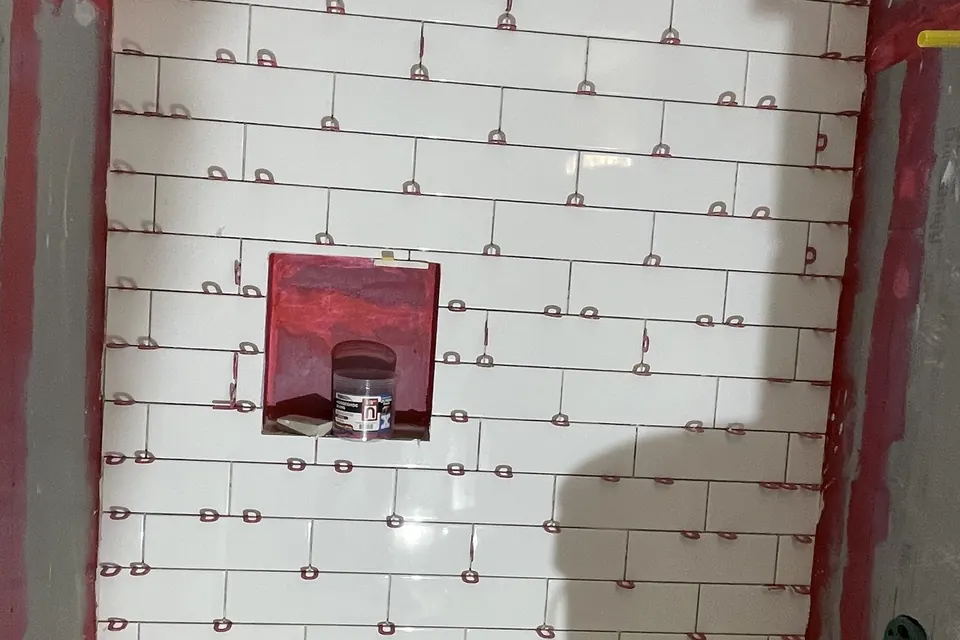
Porcelain changes the installation job because its density makes it hard to cut and less forgiving to set. A snap cutter that works on ceramic can skate across porcelain or leave chipped score lines, so clean cuts need a wet saw with a diamond blade.
Notches and hole cuts take patience even then. Porcelain also needs a mortar rated for porcelain and tighter substrate flatness, especially in the large formats most people choose now. Getting a heavy 24-inch tile flat, with no lippage and full mortar coverage, takes practice.
Tile rarely travels alone. A cracked entryway tile, a door that needs rehanging and a drywall patch can be booked together as one handyman visit. If a flooring project uncovers damaged trim or framing that needs rebuilding, that work falls under our carpentry and construction service.
More guides on assembly, mounting and home projects are listed on the SD Assembly Pros blog.
Porcelain vs. Ceramic: Frequently Asked Questions
How can I tell whether my existing tile is porcelain or ceramic?
Look at a chipped edge or the unglazed back. Ceramic shows a reddish or white clay body that contrasts with the glaze; porcelain is dense, fine-grained, and usually close to the surface color all the way through. Porcelain also feels noticeably heavier than a ceramic tile of the same size.
Does porcelain tile crack more easily than ceramic?
No — porcelain is the stronger tile. Cracks in either material almost always trace back to the installation, not the tile: voids in the thinset, a flexing subfloor, or a missing movement joint. A properly supported porcelain floor is one of the most crack-resistant surfaces you can put in a home.
Is ceramic tile good enough for a kitchen floor?
A floor-rated ceramic with a PEI class of 3 or higher can serve a kitchen well, but porcelain is the safer pick. Kitchens combine dropped pots, rolling chairs, and standing water — exactly the abuse that exposes ceramic's softer body over time. If the budget covers porcelain in a kitchen, spend it there.
Can porcelain tile be installed over an existing tile floor?
Often, yes. If the existing floor is flat, solidly bonded, and free of hollow spots, porcelain can go over it with the right primer and thinset. The added height matters at doorways and under appliances, so check those transitions first. If the old floor sounds hollow when tapped, it comes up before anything new goes down.