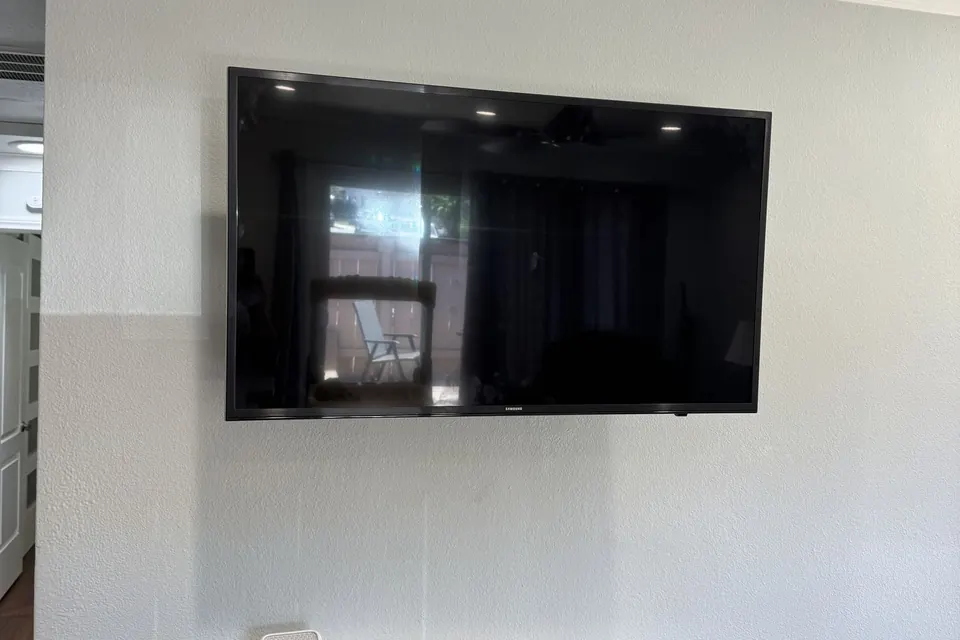
Mount your TV so the center of the screen sits at seated eye level — about 42 inches from the floor for a standard sofa. For a 65-inch TV that puts the bottom edge roughly 26 inches up. Go higher only for reclined seating, long distances, or a fireplace wall.
If that number sounds low, you are not alone. Almost everyone's instinct puts the TV too high, and a screen hung too high is the usual reason a TV gets re-mounted. This post gives you the eye-level rule, the exact math for every screen size, and the legitimate exceptions, so the holes get drilled in the right place the first time.
What Is the Right TV Mounting Height?
The right TV mounting height puts the center of the screen at your seated eye level, with your head level. Seated eye height on a typical sofa runs roughly 38 to 46 inches, which is where the 42-inch center guideline comes from. Measure your own room before you drill.
At that height your neck stays neutral for an entire movie, the picture is viewed straight-on where LCD and OLED panels look their best, and the screen relates naturally to furniture instead of floating near the ceiling.
Every few inches above eye level adds upward neck tilt, and a sustained upward gaze is tiring. That is the strain people report after mounting a TV high on the wall "because it looked right empty." Rooms are watched from sofas, not doorways.
Want your room's real number instead of the average? Sit in your usual spot, sit the way you actually watch, and have someone measure from the floor to your eyes with a tape measure. That figure — not 42 — is your target screen center. Deep, low sofas can push it down to 38 inches; tall bar-height seating pushes it past 48. Two minutes with a tape measure beats every chart on the internet, including the one below.
How High Should Each TV Size Be Mounted?
Because the center height stays fixed at eye level, the bottom edge of the TV drops as screens get bigger. A 16:9 screen's height is roughly half its diagonal (49% exactly), so the math per size works out like this:
| TV size (diagonal) | Screen height | Bottom edge from floor | Screen center from floor |
|---|---|---|---|
| 43" | ~21" | ~31.5" | 42" |
| 50" | ~24.5" | ~30" | 42" |
| 55" | ~27" | ~28.5" | 42" |
| 65" | ~32" | ~26" | 42" |
| 75" | ~37" | ~23.5" | 42" |
| 85" | ~42" | ~21" | 42" |
Practical tip: installers measure to the bottom edge, not the center, because it is easier to mark and check against furniture. Note what the table implies for big screens — an 85-inch panel's bottom edge sits about 21 inches up, close to coffee-table height. That is correct, and it is why oversized TVs look so cinematic when they are mounted properly. If a media console sits under the TV, keep 4 to 6 inches of clearance above it (more if a soundbar lives there — our soundbar setup guide covers that spacing).
Paper test: Before drilling, tape a paper outline of the TV to the wall, sit in your usual seat and look at it for a minute. With a low modern sofa the comfortable height often ends up an inch or two lower than the formula suggests. Thirty seconds of sitting beats any formula.
Does Viewing Distance Change the Height?
Viewing distance changes the right TV height only slightly. The eye-level rule assumes a normal seating distance, commonly given as about 1 to 1.5 times the screen diagonal for 4K sets, or roughly 8 feet for a 65-inch TV. At that range, small height errors are noticeable.
Sit much farther back and the vertical angle to the screen flattens, so a center an inch or two above 42 inches becomes imperceptible. The reverse is also true: in a small room where you sit close, height mistakes are magnified, and getting the center right matters most. Distance buys forgiveness; it never makes a high TV comfortable.
What About Bedrooms, Gyms, and Patios?
Bedrooms, gyms and patios all move the TV height because the viewing posture changes. The 42-inch rule assumes upright sofa seating, so a screen watched from bed, from a treadmill or from patio furniture needs a different center height. These are typical ranges, so measure your own eye level:
- Bedrooms — you watch reclined, head propped on pillows, eyes angled upward. A center height of 50 to 60 inches with a tilt mount angled down 5 to 15 degrees is the comfortable range.
- Home gyms — viewed standing or from equipment, so center the screen at standing eye level, roughly 60 to 65 inches.
- Kitchens and offices — usually viewed standing or from a stool; higher placement with tilt works, and picture-perfect ergonomics matter less for glance viewing.
- Covered patios — outdoor TVs in San Diego backyards typically hang higher for sightlines past furniture and glare, again with tilt compensating.
- Fireplace walls — the big exception, with heat and structure questions of its own. We wrote a full guide to mounting a TV above a fireplace, including the pull-down mounts that solve the height problem outright.
In every case a tilt mount is what reconciles a higher screen with a comfortable picture — the geometry of each mount style is covered in our complete San Diego TV mounting guide.
What Height Mistakes Get Fixed Most Often?
Three height mistakes account for most TVs that end up being re-mounted. They are hanging the screen at standing eye level, centering it vertically on the wall, and copying an above-fireplace height onto a plain wall. All three produce the same symptom, a good-looking room and a stiff neck.
Standing eye level happens when the TV is hung by someone standing and judged by someone standing; it is wrong the moment anyone sits. Centering the TV vertically on an 8- or 9-foot wall pushes the screen center to 48–54 inches. Copying a fireplace install onto a plain wall repeats a height that nothing forced in the first place. If your current TV has this problem, a TV mounting service can move it, and patching the old holes is drywall work covered by our handyman services.
More guides on mounting, assembly and home projects are listed on the SD Assembly Pros blog.
TV Mounting Height: FAQ
Is 42 inches a strict rule for TV height?
No — it is the starting point, not a law. Forty-two inches to screen center matches seated eye level on a standard sofa. Taller households, low-profile furniture, reclined seating, or long viewing distances can all shift the ideal center height a few inches either way.
How high should a 55-inch TV be in a bedroom?
Higher than in a living room. Because you watch from bed leaning back, a center height of 50 to 60 inches with a tilt mount angled 5 to 15 degrees downward is comfortable for most bedrooms. Lie in your normal position and have someone mark where your eyes naturally rest.
Should the TV be centered on the wall or on the seating?
Center it on the main seating, not the wall. A TV centered on an off-balance wall looks tidy when the room is empty but sits off-axis from the sofa every night. If symmetry bothers you, rebalance the wall with shelving or art around the corrected TV position.
What if the studs are not where the perfect height needs them?
Stud position almost never limits height. Studs run vertically, so the mount can sit at any height along them, and mounting plates span two studs horizontally. Most mounts also let the TV shift several inches up, down, and sideways on the plate after installation for fine-tuning.